The city of Greenville heard from residents on plans to overhaul Wade Hampton Boulevard and announced an injection of funding from the state to help pay for the project.
“It’s the beginning of transforming Wade Hampton Boulevard from an industrial corridor – which is what I think it really is (with the) speeding cars – to a neighborhood boulevard that still gets our vehicles efficiently, safely and timely up and down the road,” said City Councilman John DeWorken.
During the public meeting, Mayor Knox White announced the city received $2.5 million for the project from South Carolina’s $20 million budget for road infrastructure and utility undergrounding. The city has also budgeted $1 million for the project through the capital improvement program.
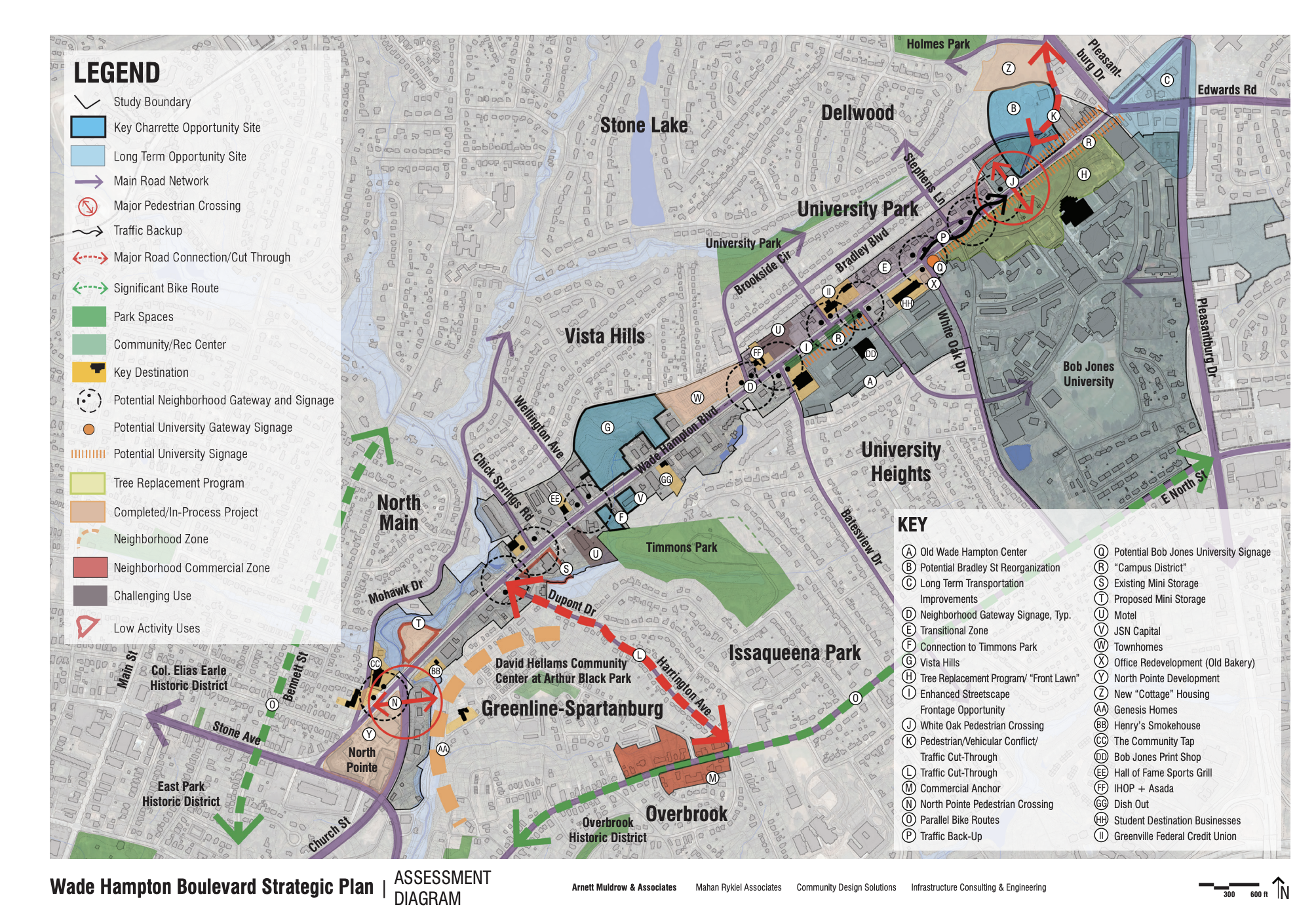
The project site consists of 1.7 miles along the corridor from Church Street to Pleasantburg Drive. To redesign this section of the boulevard, the city is working with AECOM consultants and the South Carolina Department of Transportation.
“Ultimately, the city wants to see this area revitalize from one redevelopment economic development standpoint,” said Clint Link, the city’s director of engineering services. “We want to do what we can on the boulevard to enhance (the) redevelopment of the area.
Designs for various roadway safety improvements have been presented to receive public input.
The “superstreet”
Three roadway options have been shown as possible improvements to the current corridor with two designed to turn Wade Hampton Boulevard into a “superstreet.”
Link explained a “superstreet” involves reducing a street lane from each direction.
“It would allow us to put a median down the road and establish key places where we want to allow left turns,” Link said. “Those would be strategically designed signalized to make them see intersections but it allows traffic to move.”
One of the “superstreet” options proposes a wide center median that includes green space and a shared-use path for pedestrians. Steve Mills, president of the North Main Community Association, said he thinks this option would be a nice addition and would help connect all the surrounding neighborhoods.
Reduced conflict intersections
By creating a wider center median, reduced conflict intersections, or RCI, can be created along the corridor, Link explained.
An RCI is an intersection design that changes how cars cross or turn left on major roads by using a downstream U-turn. The goal of the design is to reduce the number of conflict points or areas where vehicle paths merge, cross or diverge, along the corridor.
Kurt Wallenborn, owner of the Prosper, an executive office space on Wade Hampton Boulevard, said he believes any safety improvements along the corridor are key.
“It’s dangerous. It’s terrifying turning out of there,” Wallenborn said. “I think the biggest issue we see is we don’t want to lose access to properties. I think u-turns seem a little more dangerous than left turns especially when people are going 60 miles per hour.”
 A diagram showing a reduced conflict intersection design. Provided by the city of Greenville
North Church Street intersection roundabout
To improve the intersection at North Church Street and Wade Hampton Boulevard, a new roundabout has been proposed as a safety upgrade option.
“Roundabouts are great tools for facilitating that type of turn movement,” Link said. “ They also just keep traffic moving. We’ve got to study it more. I mean the initial analysis shows it works.”
Additional benefits of roundabouts include:
- A reduction in total crashes.
- A reduction in delays and queues.
- Provisions for walking and biking.
- Reduces vehicular emissions and fuel consumption.
White Oak Road and Bradley Boulevard realignment
White Oak Road intersects Wade Hampton Boulevard at an angled, signalized intersection. Cars often use this road as a cut through from Pleasantburg Drive to Wade Hampton.
The city began exploring the realignment of White Oak Road and Bradley Boulevard in the Wade Hampton Boulevard Strategic Plan. This realignment is expected to discourage traffic cut-throughs and help make more logical turn movements.
“We will straighten that out. (White Oak is) really close to the church parking lot, to the church daycare (and) playground area. So there are some opportunities to kind of realign the road. Definitely get some safer buffers, widen the road a little bit to accommodate sidewalks.”
Residents are encouraged to provide feedback on the project through an online survey conducted by the city and AECOM.
For more information on the Wade Hampton Improvement project, visit the city’s website.