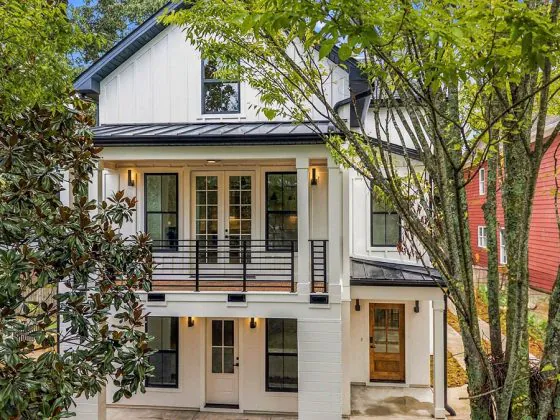
Along the idyllic streets that make up Greenville’s seven historic districts, homes with ornamental facades, quaint porches and lush flower gardens chaperone those who happen by.
The districts are historic both in age and by official designation, ones the city of Greenville saw fit to formally honor for their contribution to the city’s growth.
Mapping History – scroll over the districts for interesting facts
[wpcmtt_hotspot id=”261702″]These are quiet neighborhoods where ivy-covered stone walls mark the passage of time and stately trees give shade to young parents pushing babies in strollers and whose dogs trot on leashes and kids coast along on bicycles.
Stand still in the right spot, and you could be looking at a post card.
But when local historian Teresa Slack walks through these neighborhoods, she sees something different.
“The thing that saddens me is people don’t want to delve into the actual history,” Slack says. “They want this one little cube. They want to look at the pretty houses. But you can’t just compartmentalize it. What created that neighborhood? What created that area?”
For her, the homes are bittersweet monuments. Where some see stately lawns and picket fences, Slack sees smoke and dust. She hears the groaning of machines, the roar of rushing water. And she sees countless faces — the grimy, lint-covered faces of the men and women whose effort and hope built Greenville’s textile industry.
“These were definitely scrappy environments. These people came to build a better life,” Slack said. “And you know what? They did build a better life.”
Here are seven brief windows into the districts that built Greenville’s history.

Colonel Elias Earle Historic District
Home styles: Neo-Classical, Dutch Colonial, Georgian Revival, English Cottage, and Tudor
Key landmarks: Whitehall and the Earle Town House
Local significance: Home to two of Greenville’s oldest landmarks
The Colonel Elias Earle district shares its name with the man who pioneered the area, Col. Elias Earle. Although he would later be known as “a prominent, early nineteenth century Greenville citizen,” according to the National Historic Register, Earle actually purchased the land north of town when he was an early settler in the 1700s.

The district is home to a pair of Greenville’s oldest landmarks. The first, built in 1813, is “Whitehall,” 310 West Earle St., the former summer residence of Gov. Henry Middleton The second, built around 1820, is the Earle Town House, 107 James St.
Earle’s family went on to purchase more land in 1834, quietly building up the neighborhood along what are now Earle and James streets. The area witnessed soldiers returning from fighting in the Civil War and the Spanish American War, but it wasn’t until the end of the First World War that the district began to flourish as a neighborhood. Today, it is a snapshot of a world that, in many ways, only existed in the 1920s.

East Park Historic District
Home styles: Craftsman, American Foursquare, Tudor, and Neo-Classical
Key landmark: McPherson Park
Local significance: Was a model of early community development
The East Park neighborhood serves as a testament to one man’s vision for how a community should be built.
In the late 1800s, the area along East Park Avenue began to take shape, with one man playing a major role: W.C. Cleveland. It didn’t hurt that Cleveland had been both the mayor and a member of the South Carolina House of Representatives.

Cleveland rose to prominence during an era of massive cultural and technological change. The quiet agrarian lifestyle that had remained unchanged for centuries was being rapidly replaced by a more urban, chaotic and uncertain societal structure.
With that came lofty ideals for how society should best respond to that industrial revolution. In Cleveland’s case, a sense of public stewardship and community development led him in 1887 to bequeath a large piece of his land along East Park Avenue which he hoped would serve as a community park. Today, that land is McPherson Park.
The remaining area along East Park Avenue was subdivided in 1910 and peaked in development in the 1830s, retaining that style to this day.

Hampton-Pinckney Historic District
Home styles: Queen Anne, Craftsman, Gothic Revival, Colonial Revival, Italianate, and Prairie
Key landmark: J.M Greer House
Local significance: Greenville’s first “trolley car neighborhood”
At the turn of the 20th century — on Jan. 1, 1901, to be exact — residents living in Hampton-Pinckney walked one block to Main Street where they watched the first trolley come chugging down the rail lines. That formative moment would spur decades of home construction in the neighborhood as more and more Greenvillians sought to live in what soon became known as the area’s first “trolley car neighborhood.”
But the history of Hampton-Pinckney began in 1815 when Vardry McBee, the “father of Greenville,” paid about $27,000 for more than 11,000 acres of land.
That land would become the wellspring for the educational and spiritual growth of Greenville. As more people drifted into the small prairie town that Greenville was in those days, McBee donated portions of the land to the Greenville Male and Female Academies, as well as spots for the city’s first four churches. The first home was built on the land just before the Civil War, while residential lots were subdivided in the late 1890s.
By the turn of the century, when the trolley car first clanged down Main Street, the area was booming. Money from the textile mills saw the rise of fancy homes that remain just as beautiful today as they were a century ago.

Heritage Historic District
Home styles: Bungalow
Key landmark: St. George Greek Orthodox Cathedral
Local significance: Was once home to a vineyard and dairy
If its name is any indication, the Heritage neighborhood’s very existence pays homage to its own lineage.
The architectural style of the homes lining the streets is an example.
“Heritage neighborhood is an arts and crafts-era neighborhood,” said John Edwards, president of the Heritage Neighborhood Association, speaking in a video overview of the area. “It’s mostly made up of bungalow-type homes, although there are other housing styles represented in the neighborhood. It’s unique in Greenville in that it’s very close to downtown.”

That proximity to downtown would have surprised the early residents, as the land was once the site of a large vineyard along what is now Wilton Street. W.C. Cleveland purchased the vineyard in 1909 and for many years, the agricultural operations on the land, including a working dairy, coincided with the growth of the neighborhood.
That growth led to the creation of the St. George Greek Orthodox Church nearby, and the area became a settlement for Greek immigrants and the growing Greek community.
Today, many of the homes once occupied by those agricultural workers are still standing, even as the vineyards and dairy cows have been replaced by restaurants, offices, retail stores and sidewalks.

Overbrook Historic District
Home styles: Craftsman Bungalow
Key landmark: The former trolley line, now gone.
Local significance: Built by the Woodside brothers of Woodside Mill
While Hampton-Pinckney has earned the distinction of being the first “trolley car neighborhood,” Overbrook holds perhaps an even greater claim to the trolley car title, for its very existence is due to the expansion of the trolley line.
That expansion to a new terminus in 1910 gave Greenville residents easy access to the outskirts of the city. The expansion also gave some of the city’s most prominent businessmen an idea.

A growing middle class was taking shape in Greenville as the wealth from the textile mills flowed in. That meant a corresponding need for middle class housing. In 1913, the Woodside brothers, who build their fortunes through the Woodside Cotton Mill, once the largest textile plant in the world, formed the Overbrook Land Company to address this problem.
The Woodside brothers purchased land on the eastern edge of Greenville near the trolley line and later sold it to R.J Rowley, a farmer turned developer. Rowley constructed the first homes in what would become the Overbrook neighborhood. Consider it the very Greenville suburb, as wealthier, white collar residents flocked to the area to raise their families. That relative affluence gave shape to the larger home sizes in Overbrook compared to other historical districts.
With the trolley system, men had an easy time getting to and from work, and even after the advent of bus transportation in the late 1920s, the trolley continued to be a popular attraction among neighborhood residents.

Pettigru Historic District
Home styles: Queen Anne, Bungalow and Colonial Revival, among others
Key landmark: Hayne School Building
Local significance: Greenville’s largest historic district

Walking through Pettigru, the largest historic district in the city, offers a unique opportunity for a master class in the evolution of home architecture, ranging from the Victorian era to the 1930s. Nowhere else in the city can one find such a broad range of styles situated so close together.
The evolution of that architecture reflects the growth of Greenville during the same time period. The area was once occupied by two large family estates, those of the Rowley family and that of James Boyce. The subdivision of the great “Boyce Lawn” in 1907 served as the unofficial beginning of the neighborhood Pettigru would later become, as Victorian cottages began to rise up across the area.
Prominent businessmen and mill owners made up the early residents of the district. Even though today the area is split between residential and commercial development, the architecture of those early homes still serves as so many time capsules from that era.

West End Historic District
Architectural styles: Early 20th century commercial
Key landmark: Fluor Field
Local significance: The only commercial area among Greenville’s historic districts
The West End might be known today as a growing commercial pocket of downtown, but when it was first settled in the 1830s, it was just a small collection of tiny homes. It wasn’t until Furman University was established nearby in 1852 and the first train arrived from the Columbia Railroad one year later that the area truly revved to life.
Students and professors arrived by train to the university, and from the university they settled in the surrounding area of the West End. Businesses popped up alongside residential construction. Cotton and fertilizer warehouses were plentiful. New churches attended to the spiritual needs of the new residents, while schools attended to the education of the children who grew up in the scrappy new district.

While the businesses have changed, the early character of the district lives on in a growing commercial hub that is even livelier today than it was more than 100 years ago.
Today, you won’t find the kids of cotton warehouse workers playing stickball out in the street, but you can still hear the crack of a baseball bat on summer nights in Fluor Field.